



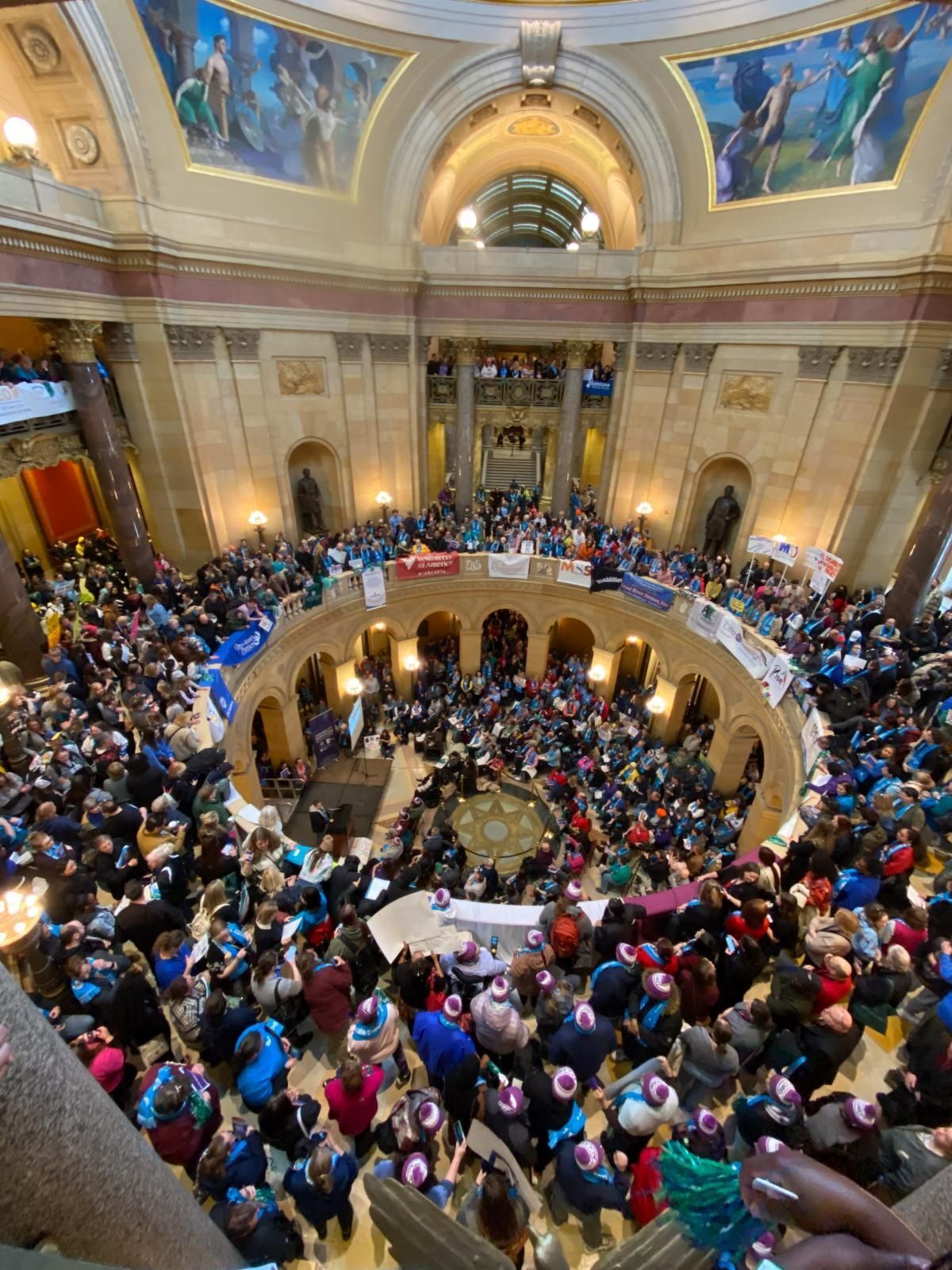
The 2026 Disability Services Day at the Capitol, Minnesota’s largest rally celebrating and advocating for people with disabilities and the dedicated professionals who support them, is only one week away! MOHR has put together suggestions to start preparing for the big day.
Before You Go
Have a Poster Making Day
Ask self-advocates if they would like to make posters to hold during the event. Posters are a great way to show enthusiasm, communicate your message, and get creative with colors and designs. Use large, high-contrast letters so that your message can be easily read. Please note that sticks and poles attached to posters are not allowed within the Capitol building, so be sure your poster is handheld only.
Legislator Meeting Sheet
If you have signed up to meet with your legislators, consider writing out an introduction letter and some discussion prompts. This can help you prepare for the possibility that you may meet with your legislator's staff instead of meeting with your legislator directly. In your introduction letter, be sure to include your organization's name, your location, and the names of everyone in your group. It is also helpful to include quick statistics on services provided, people served, and community impact. This introduction can be printed to give to the legislator's team. You can also prepare a list of questions and discussion points. While many will be serious, it is also okay to include some lighter questions. Include self-advocates in the writing process so they can have their questions answered. If you need help deciding what to talk about, MOHR has created a one-page handout outlining the top priorities for Disability Services in the 2026 Legislative session.
Make Cards for Legislators
If your group has signed up to meet with your legislator, ask if self-advocates would like to write personal notes to their legislator. Legislators love to hear from their constituents and would appreciate the thoughtful touch. This can also help everyone get a chance to say something to their legislator, even if time gets short on the day.
Double Check Media Approvals
This is a great time to double-check the media approval status of everyone in your group. Photography and videography are encouraged at the Day at the Capitol, and it is always great to share your advocacy with your community. Knowing in advance who can and cannot appear in pictures can save time and confusion. Because the Capitol building is a public place, any news media may take photo or video of people who are present.
What to Bring
Show Your Colors
This is a great opportunity for self-advocates to dress in any organization's clothing or colors. Not only does it show pride in your organization, but it can also help keep everyone together and help reunite individuals who may get lost. You may also bring signs, organization buttons, and support messages into the Rotunda.
Photography and Videography
Photography and video recording are allowed and encouraged! However, please be mindful when using flash photography, as some attendants may be sensitive to sudden bright lights. Also, be cautious if planning to bring a tripod; the Rotunda can become quite crowded, so please leave room for others and consider leaving expensive equipment at home if you are concerned it might be knocked over.
Accessibility, Aids, and Tools
While efforts are made to make the Disability Services Day at the Capitol accessible for everyone, there may be some aids and tools that you choose to bring. Cheering at the rally can be loud at times, so consider if earplugs or noise-cancelling headphones may be appropriate. The noise level can also make it difficult to hear, so be prepared with writing paper or communication apps. Consider whether a mobility aid would be helpful, as seating is limited, and the rally usually lasts about one hour, with the legislator meetings to follow. All floors of the Rotunda are accessible by three elevators. Service animals are welcome. Restrooms with accessible stalls are located in the northeast section on every floor. You can find more information on Accessibility on the Minnesota Historical Society's Minnesota State Capitol Accessibility page.
Be Aware of New Security Screenings
Starting in February 2026, all visitors to the Minnesota Capitol Building will be required to undergo additional security screening, including limited entrances, bag scanners, and walk-through scanners. The screening entrances are ADA accessible, and staff will be available to assist people with disabilities, medical devices, strollers, or service animals. These new screenings may cause delays, so be prepared to arrive early. You can find out more about the new security measures on the Minnesota Department of Public Safety State Patrol website under Plan your visit to the Minnesota State Capitol.
No Food or Liquids Within the Rotunda
Food is available in the Capitol Complex at the Centennial Office Building Cafeteria and the Rathskeller Café Cafeteria. Both locations are open from 8:00 in the morning to 1:30 in the afternoon. Feel free to bring your own lunch or snacks to eat in either of these cafeterias. Please note that there is a strict policy of no food or beverage in the Capitol Rotunda, where the rally will take place.
Prohibited Items
In addition to food and beverages, Minnesota bans the following items from Capitol Building premises: firearms unless authorized, explosives, ammunition, knives, blunt-force objects, clubs, batons, items deemed dangerous by security, illegal substances, alcohol, balloons, noise-makers, bullhorns, megaphones, light sticks, poles, spray paint, spray chalk, sidewalk chalk, tape including duct, gaffer’s or masking tape, candles, and open flames. If anyone in your group will be legally carrying a pistol with a valid permit to carry, they must inform security before entering the screening area and present their valid permit to carry and a government-issued ID.
Be Weather Aware
Mid-March can be an uncertain time for the weather in Minnesota. While the Capitol Building and Rotunda itself are temperature-controlled, the lines to enter the Capitol Building can be long, slow-moving, and exposed to the elements. Be prepared to stand outside for up to 30 minutes, and ensure that everyone has weather-appropriate clothing.
Plan Your Arrival
When to Arrive
The rally will begin at 10 am on March 24, 2026, with legislator meetings to follow. The rally is open to all, and there is no need to register. Due to possible road conditions, limited parking, increased security screening times, and limited seating, plan to arrive early to get the best available seats. However, the doors will remain open, so don't worry if you arrive a little late.
Getting to the Capitol
The correct address for the Minnesota State Capitol is 75 Rev. Martin Luther King Jr. Blvd. St. Paul, MN 55155. The Capitol Building Complex is accessible from the east and west on I-94 and from the north and south on I-35E. You can find more travel directions on the Minnesota State Legislature website. Please be aware that road conditions and closures can change suddenly, especially during the morning commute. Consult the Minnesota Department of Transportation Traffic Map before you begin your trip or call 511 for real-time updates.
Paratransit drop-off and pick-up zones are located on Cedar Street east of the Capitol Building, at the Minnesota Senate on Park Street, near Ramp F off of Rice Street near the State Office, and at Andersen on Cedar Street near the 10th St. Station. There are also Bus Routes surrounding the Complex.
The Metro Green Line Light Rail also has several stations within the Complex. The nearest Metro Light Rail Station is Capitol/ Rice Street Station on the corner of University Avenue and Rice Street. Robert Street Station and 10th Street Station are also within the Complex.
You can learn more about Public Parking and Transportation options through the MN Department of Administration Public Parking webpage.
Where to Park
Metered ramp and lot parking is available within the Capitol Complex. Limited metered street parking is also available, but does fill up fast. Disability Parking is available throughout the Capitol Complex, with the closest option in the Minnesota Senate Garage across University Avenue. For lots south of the Capitol Building, be mindful that the Capitol Building is on a hill, so the walk up may be steep and slippery depending on weather conditions. Meters can be paid with Visa and MasterCard credit and debit cards, $1 and $5 bills, and coins. Parking can be paid at $2.00 per hour or $8.00 for an all-day rate. You can find a detailed Parking Map here.
Capitol Building Maps
The Minnesota State Capitol map details the locations of the public entrances, weapons screening, restrooms, and elevators. Currently, only four entrances are available: the ground floor public entrance, the basement tunnel to the Minnesota Senate building, the basement tunnel to the State Office building, and the basement tunnel to the Minnesota Judicial Center. Every entrance will have mandatory weapons screenings. Signage and staff will be able to direct to the Rotunda.
Disability Services Day at the Capitol Events
The Rally
The rally will begin at 10 am in the Capitol Building Rotunda. The speakers' stage will be set up in the middle of the Rotunda, with limited seating provided in front. The Rotunda has two upper levels that overlook the speaker. Be sure to arrive early for the best viewing. All levels of the Rotunda are accessible via elevator; elevator lines can be long, so arrive early and be prepared to wait. During the rally, multiple legislators will be introduced and speak in support of Disability Services. The rally will last approximately an hour.
Meetings with Legislators
Immediately after the rally, groups that have already registered to meet with legislators will be directed to their meeting rooms. Meetings will continue throughout the day. This year, everyone wishing to attend legislator meetings MUST have already registered in advance.
After the Day at the Capitol
Tag MOHR in your DATC Social Media Posts
We want to highlight MOHR members' advocacy at this year's Disability Services Day at the Capitol. Tag us in your posts using #MNDAC26 and #MOHRMATTERS, and your pictures may be featured on the MOHR Facebook page and the March Newsletter.
Participate or Host Advocacy Events
Attend advocacy events such as local chamber advocacy Days at the Capitol or legislative wrap-up events. These events provide opportunities to network with other advocates and engage directly with policymakers. Whether you were able to meet with your legislator this year or not, establish and maintain relationships with local, state, and federal policymakers. These relationships can go a long way to help them understand the needs and challenges of the disability community in their area. Consider inviting them for a tour of your facilities or attending local governance meetings. If meetings are open to the public, ask your participants if any would like to attend with you as self-advocates.
Get Involved with MOHR
One way of continuing your advocacy is to get involved with MOHR. Whether you are contributing to the MOHR discussion board, attending MOHR board meetings, using MOHR-provided resources in your community, or participating in one of MOHR's committees, MOHR encourages all members to continue engaging with one another and help drive positive change.
Register for the MOHR Spring Conference
Join professionals from across Minnesota and beyond for the 2026 MOHR Spring Conference, a dynamic three-day event designed to inspire, educate, and connect under this year’s theme: “Together we learn, Together we lead, Together we thrive: Empowering every voice,” will be held June 1-3, 2026, at the Park Event Center, 500 Division Street, Waite Park, MN, 56387.
