



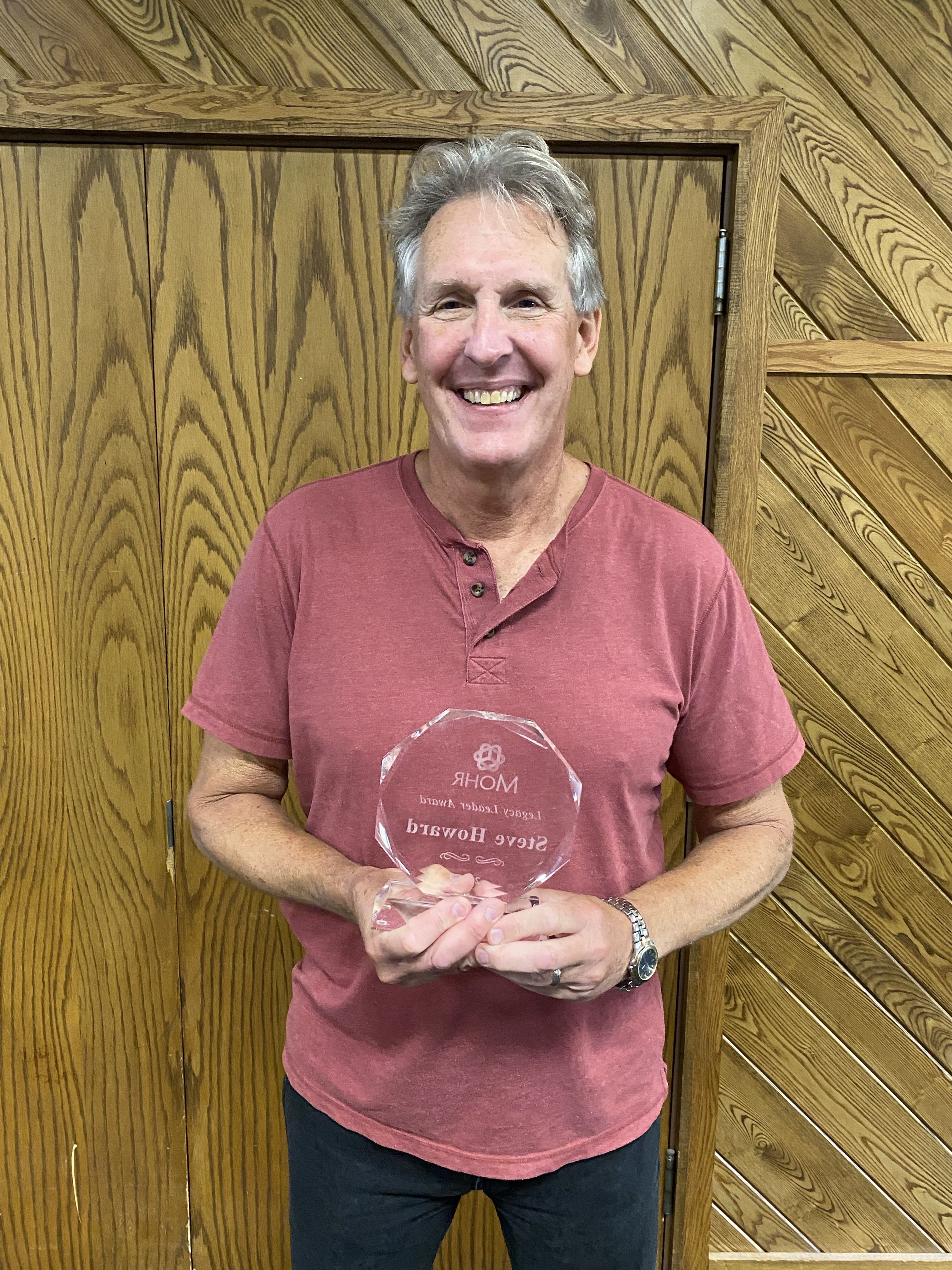
MOHR is pleased to recognize Steve Howard’s outstanding contributions with the 2026 Legacy Leader Award. The Legacy Leader Award recognizes individuals with 20+ years of dedicated service in disability services who have played a pivotal role in shaping the MOHR association. This award honors retiring or recently retired longtime MOHR members who have made profound contributions to the association’s mission and impact. Over his 35-year career in disability services, Howard has served as a leader, educator, advocate, and inspiration. “It’s amazing to be honored and considered in a group of individuals I have seen receive the award,” said Howard. “It is wonderful company to be in…I am so incredibly honored and privileged to have worked with such an amazing group of professionals in MOHR, and people served. Between the two, I learned an incredible amount.”
Howard’s connection to the disability community began at home, caring for his medically complex brother despite prevailing trends toward institutionalization. As a military family, they moved frequently but remained committed to home care. Howard attended college in North Carolina for criminal justice. He and his family then moved to Minnesota, where he considered officer candidate school for the Air Force and intended to follow in his father’s military footsteps. While studying, Howard started his career at Goodwill in Minneapolis, MN, as a DSP through a social services employment agency. A standout employee, he was recruited to management in only a couple of years. Howard thrived in leadership, excelling by combining supervisory skills with personal experience.
Howard advanced to a director role at Midwest Special Services (MSS), later becoming vice president. During his tenure, he trained as a Commission on Accreditation of Rehabilitation Services (CARF) Employment Community Services surveyor. CARF is a global organization dedicated to improving disability service standards through education and accreditation. Howard consistently met and exceeded these standards, making him a valuable asset to his organizations. His work with CARF increased the quality and accountability of services at MSS, helping programs implement best practices and achieve better outcomes for the people they served. “I really believe in it. I wouldn’t have been doing it for three and a half decades if I didn’t.” He is qualified to accredit both Programs and Administration as a solo surveyor.
After 21 years at MSS, Howard became Executive Director at WACOSA in Waite Park, MN. There, he led several initiatives, including achieving accreditation for all programs. He served in this role for 14 years until retiring in 2022. Howard continues to work as a CARF surveyor, traveling nationally and internationally.
Howard’s personal experience informs his leadership: “I understand, having had a brother with disabilities, I understand being a family member receiving services, and I also understand being a service provider. Both of those perspectives make me uniquely balanced in the way that I see things.” He has consistently recognized the challenges families face and balanced these with provider and administrative perspectives.
Over his lifetime and career, he has seen many positive changes in disability services, starting with deinstitutionalization when he first entered the field. “I never had a desire or a support for institutions.” A forward-thinking person, he has learned to understand his predecessors who had to make decisions with their limited information and capabilities. “Every point in history is a point to grow in. It's so much easier to look back in hindsight.” Howard is a strong proponent of the rise of the person-centered and choice-centered philosophy, “Going from ‘This is what we are going to give your brother’ to ‘What does your brother want for services?’ I really believe this evolution to person-centered philosophy is a wonderful thing that we have seen evolve.”
Howard is a strong advocate for disability employment and fair compensation across ability levels. He supports flexible wage options, including special minimum wage, as a means to empower individuals with high-needs disabilities. “My brother was very involved, behaviorally and medically fragile. He had a lot of issues going on, but he loved to work… He packaged pencils for the state of Minnesota and might have packaged 3 pencils all day long…there is no way that an employer would pay minimum wage for my brother packaging three pencils a day.” Howard emphasizes fair pay for fair work. “We all seem to have an innate thing inside of us that says we know if we are being productive…People with disabilities have the right to work. They should be able to decide if they want special minimum wage because they are the ones who can’t work if you take that choice away.”
Howard anticipates future challenges such as funding constraints, staffing shortages, and the impact of artificial intelligence. He credits staff for upholding high standards of care: “We have to let our legislators know how important it is that we continue to get cost-of-living adjustments to keep really good people working with our people.” He cautions against excessive use of AI in support roles: “Human services is human.” Howard believes that when it comes to helping people with barriers, direct support and direct intervention with other people is the best for the people that they serve. “The human touch is very important.”
Howard’s advice to future leaders is clear: “Be durable… The effort is worth it. This is a marathon, not a sprint.” He has prioritized authenticity in leadership. “I've never done anything to look good doing it…It has been an evolution for me, growing through this industry professionally and personally. I have learned to be authentic with my staff. It means being vulnerable, respecting your staff, and admitting when I have made a mistake.” Howard encourages leaders to acknowledge the ongoing challenges in the field. “I remember when I was a kid, and every single time we had a legislative session roll around, I would say, ‘Holy crap, it's got to get better than this. I’m sure next year will be better.’ I spent almost 40 years doing that… It is very much an integral part of what we do that there are consistent challenges and hurdles... That, as much as any reason, is a reason that our people need us. They have got to have us in there swinging and slugging on their behalf.”
